
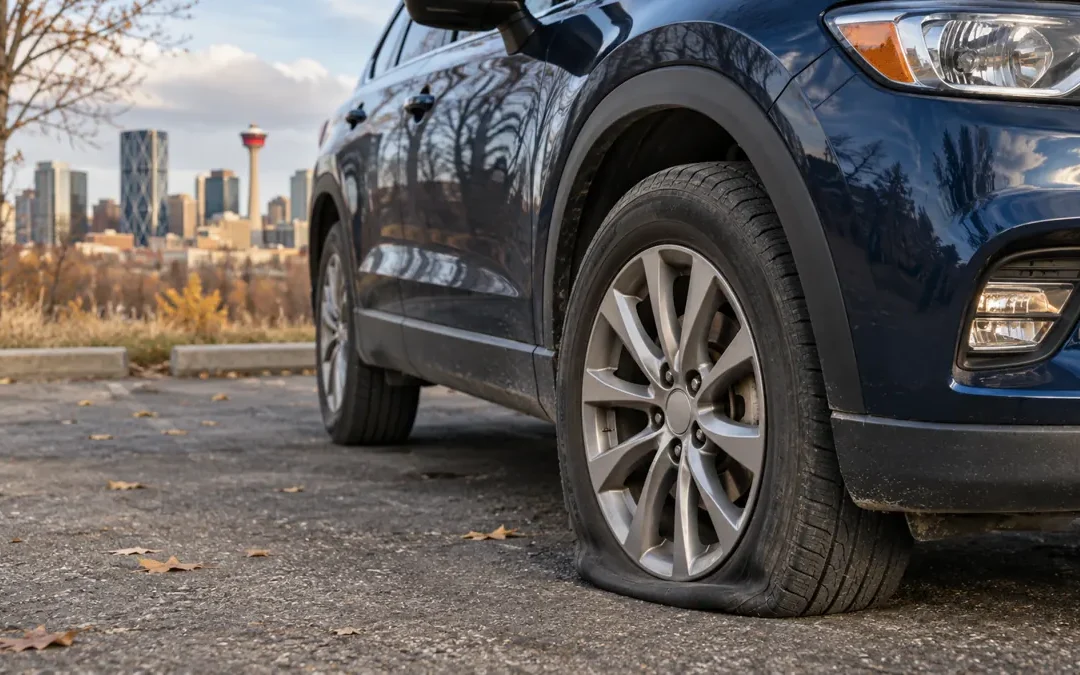
Do not drive to a Calgary tire shop on a conventional flat tire. Stop as soon as you can safely do so. Once stopped, choose a suitable spare, manufacturer-approved run-flat guidance, or roadside assistance in Calgary. A shop being nearby does not make driving on a flat safe.
A flat tire outside your home in Calgary is frustrating. The same problem on Deerfoot Trail raises a different question: how do you stop safely without turning a tire problem into a roadside emergency? This guide separates the immediate safety decision from the next step: changing a wheel, arranging inspection, or requesting a tow.
Share your location and whether you have a usable spare. Confirm the available service and quote before booking.
How far can you drive on a flat tire?
There is no general safe distance for driving on a conventional flat. Continuing can damage the tire internally and harm the wheel. The vehicle may also handle unpredictably. Avoid treating “just one more exit” or “only a few blocks” as permission to finish your journey.
If the problem starts while driving, keep control, avoid abrupt manoeuvres and slow progressively toward a safe stopping position. Immediate traffic danger matters; do not stop deliberately in a live lane if you can safely reach a safer position. Once stopped, do not resume the trip on the damaged tire.
For injury, fire or immediate danger, call 911. Do not attempt a wheel change beside moving traffic or on unstable ground. Follow emergency responders’ instructions if they attend. Our Alberta slow-down and move-over guide explains how approaching drivers should respond to roadside workers.
Flat, low pressure or run-flat: know the difference
Calgary temperature changes can affect pressure, but a visibly collapsed tire, rapid pressure loss or unusual handling should not be dismissed as cold weather. Stop and arrange assessment. Run-flat construction also does not mean every puncture remains repairable after driving.
What if you have a flat tire and no spare?
First establish what the vehicle actually carries. Some have a spare wheel; others have a compressor and sealant kit. A compressor alone cannot fix structural damage, and a kit is not suitable for every puncture. Follow its instructions and tell the operator if sealant has already been used.
With no usable spare, discuss transport to a tire shop. Ask the shop whether it can accept the vehicle and inspect the tire when you arrive. An open reception desk does not necessarily mean your tire size is available or that a repair can start immediately.
Our guide to roadside tire changes in Calgary explains what to confirm before booking. A spare-wheel change, puncture repair and fitting a new tire are separate jobs; do not assume one call includes all three.
If the shop is closed, ask where the vehicle may be left and how keys should be handed over. Confirm permission before arranging delivery. Keeping the destination and access details clear helps avoid a second move or an unsuitable drop-off.
Discuss your vehicle, access and receiving shop with an operator before arranging transport.
A temporary spare changes your next journey
A temporary spare is a way to reach appropriate tire service within its stated limits, not a replacement for normal driving. Check the spare’s condition, inflation requirements and vehicle compatibility before installation. Use the speed and distance restrictions for that particular spare and vehicle.
Plan the route around those restrictions. A direct highway route may be unsuitable for a temporary spare. If you cannot identify a suitable route or confirm the instructions, ask about towing your car to a repair shop instead. Several damaged tires, a damaged wheel or a missing wheel-lock key can also change the plan.
Can the flat tire still be repaired?
A tire professional must assess the damage. Some small central-tread punctures may qualify for repair after internal inspection. Sidewall damage, shoulder damage and driving on a flat can rule out a routine puncture repair. A photo or a tire holding air briefly cannot establish that it is safe.
Tell the shop whether you drove after losing pressure, hit a curb or pothole, or used sealant. Those details help the assessment. Avoid ordering a roadside “patch” simply because it sounds cheaper than transport; confirm what inspection and work are actually included.
Make a Calgary pickup easier to assess
On Deerfoot, Stoney or Glenmore Trail, give the direction of travel and nearest exit or cross street. A map pin helps, but does not replace explaining which carriageway you are on. In a parkade, provide the entrance height, level and stall; see our low-clearance towing in Calgary.
- Identify the vehicle, affected wheel and whether it can roll.
- Describe traffic exposure, snow, ice or restricted access.
- Confirm the spare and wheel-lock key, if available.
- Name a receiving destination if towing may be needed.
Ask for the complete service quote and the charge if a wheel change cannot be completed. If transport is necessary, discuss vehicle requirements through our flatbed towing in Calgary. Our towing cost checklist helps separate loading, distance and additional work.
Flat-tire questions Calgary drivers ask
Can I drive slowly on a flat to save a towing charge?
Slow speed does not make a conventional flat safe. Once safely stopped, arrange an appropriate spare or assistance instead of continuing toward a shop.
Does roadside assistance bring a replacement tire?
Not automatically. Confirm the service offered, tire availability and any separate fitting costs. A roadside spare-wheel change uses a suitable spare; replacement and repair need separate confirmation.
Who should I call in Calgary if I have a flat tire and no spare at night?
Once safely stopped, contact roadside assistance and explain that you have no usable spare. Ask whether towing is needed and confirm a receiving destination before dispatch. If the tire shop is closed, get permission and drop-off instructions first. Call 911 for immediate danger or injury.
Should I tell the operator if I used tire sealant?
Yes. Tell both the roadside operator and the tire shop which product you used and whether you drove after the pressure loss. A sealant kit does not establish that the tire is safe or repairable; the tire professional still needs to assess the damage.
What details should I give when requesting help for one flat tire?
Give your exact Calgary location, vehicle details, affected wheel, spare availability and wheel-lock key status. Mention a parkade height restriction or traffic exposure. Ask what the quote includes and what happens if a spare-wheel change cannot be completed.
Need help with a flat tire in Calgary?
Calgary Tow Truck connects you with independent operators. Explain your location, vehicle and spare situation, then confirm availability, arrival estimate and the full quote before booking.
Safety references: Transport Canada: tire inflation; manufacturer tire-repair guidance. Always follow your vehicle and tire instructions.