
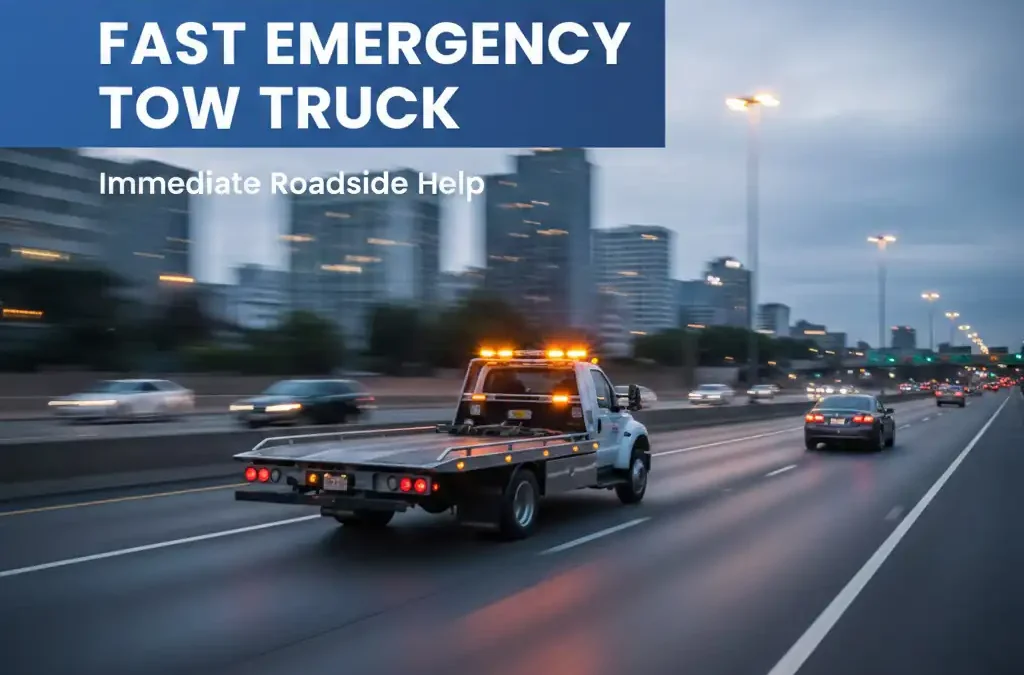
Slow Down Move Over Law Alberta: What Every Driver Must Know
Alberta’s Slow Down Move Over law exists to protect the people who stand between you and danger on the roadside, police officers, paramedics, firefighters, tow truck operators, highway maintenance crews, and snowplow drivers. Every day in Alberta, these workers risk their lives on the side of active highways while vehicles fly past at 100+ km/h just metres away. The law is simple: when you see flashing lights on a stopped vehicle, you must move over to the far lane or slow down to 60 km/h. Breaking it carries a $243 fine and 3 demerit points. This guide covers everything Calgary and Alberta drivers need to know about the law in 2026.
⚡ The Law in 30 Seconds
🚨 What to do: Move over to the far lane when passing any stopped vehicle with flashing lights. If you cannot move over safely, slow to 60 km/h (or the posted limit if lower).
🚛 Applies to: Police, ambulances, fire trucks, tow trucks, snowplows, highway maintenance vehicles, and all roadside workers with flashing lights.
💰 Penalty: $243 fine + 3 demerit points. Snowplow violations: $324 + 3 demerits.
📋 Law source: Alberta Traffic Safety Act, Use of Highway and Rules of the Road Regulation (updated Sept 2023).
What Is the Slow Down Move Over Law in Alberta?
Under Alberta’s Traffic Safety Act and the Use of Highway and Rules of the Road Regulation, drivers must take specific actions when approaching any stopped vehicle with flashing lights activated on the side of the road. The law applies on every highway, street, and road in Alberta, not just freeways.
The core requirements are straightforward:
Move Over to the Far Lane
On a multi-lane road, change lanes to put a full lane of space between you and the stopped vehicle. This is the preferred action and provides the most safety for workers on the roadside.
If You Cannot Move Over, Slow to 60 km/h
If changing lanes is not safe (traffic, single-lane road, or obstructions), you must reduce your speed to 60 km/h or the posted speed limit, whichever is lower. This applies in all lanes travelling in the same direction on divided highways.
On Two-Lane Roads, Both Directions Must Slow Down
On single-lane undivided roads, drivers travelling in both directions must slow to 60 km/h when passing stopped vehicles with flashing lights. There is no barrier between you and the worker, the danger is real from either direction.
Important definition: A “flashing light” under the Alberta Traffic Safety Act means a stationary or rotating flashing lamp, strobe lamp, or 360-degree warning lamp. It does not include regular signal lights or hazard flashers. However, as a driver, if you see any kind of flashing lights ahead, slowing down and moving over is the safe and legal response regardless of the technical definition.
Who Is Protected by the Slow Down Move Over Law?
The law originally protected only first responders and tow truck operators. As of September 1, 2023, it was expanded to cover all roadside workers with flashing lights activated:
🚔 Police Vehicles
Traffic stops, accident scenes, impaired driving checkstops
🚑 Ambulances & EMS
Roadside medical emergencies, collision scenes
🚒 Fire Trucks
Vehicle fires, hazmat spills, accident extrication
🚛 Tow Trucks
Roadside towing, accident recovery, vehicle loading
❄️ Snowplows
Highway clearing, salt/gravel spreading operations
🔧 Maintenance Vehicles
Highway repair crews, utility workers, road marking teams
As a towing company that operates on Calgary’s busiest highways daily, this law matters deeply to us. Our operators stand beside live traffic on Deerfoot Trail, Stoney Trail, Crowchild Trail, and Highway 1 while loading vehicles, sometimes in the dark, in winter storms, or in rush-hour congestion. Every time a driver blows past at full speed without moving over, it puts our team in danger. We are not asking for special treatment. We are asking you to follow the law, and potentially save a life.
Fines and Penalties for Violating the Move Over Law
Alberta’s penalties for violating the slow down move over law are structured as follows:
⚠️ Note: The $243 move over fine is separate from any speeding fine. If you are caught doing 110 km/h past a stopped tow truck in a 110 km/h zone, you will receive the $243 move over fine plus potential speeding demerits because you were required to be at 60 km/h. Demerit points from both violations accumulate on your record and affect your insurance rates.
For context on how Alberta’s broader towing regulations protect drivers, see our guide on the new Alberta towing laws effective 2026.
Calgary Police “Slow Down Move Over” Campaign, March 2026
On the evening of March 5, 2026, the Calgary Police Service staged a major awareness event along 16 Avenue NE (Trans-Canada Highway), between 36 Street and Barlow Trail NE. Ambulances, tow trucks, fire engines, peace officer vehicles, highway maintenance trucks, and police cruisers lined both directions of one of Calgary’s busiest roads with their flashing lights activated, a visual reminder of the workers who stand beside traffic every day.
The campaign highlighted a critical reality: despite the law being in effect since 2023, compliance remains inconsistent. The Alberta Motor Association (AMA) has documented at least 36 near-misses and 14 serious roadside incidents involving Alberta tow trucks and passing vehicles since December 2019. Highway maintenance contractors report over 128 collisions involving snowplows in a three-year period.
These are not abstract statistics. These are real people, our colleagues, our operators, and the first responders who help you when you are in trouble. The March 2026 event was a reminder that the law exists because people are getting hurt. Following it is not optional.
Real Scenarios: How to Apply the Law on Calgary Roads
The law sounds simple in theory, but real-world Calgary driving creates situations where drivers need to think quickly. Here are common scenarios and what to do:
Scenario 1: Tow Truck on the Shoulder of Deerfoot Trail
You are driving northbound on Deerfoot Trail in the right lane at 100 km/h. Ahead, you see a tow truck with amber flashing lights loading a vehicle on the right shoulder. What to do: Check your mirrors and blind spot. If the left lane is clear, move over. If the left lane is occupied and you cannot merge safely, slow to 60 km/h while passing. Resume normal speed once you are past the scene. Do not slam on your brakes, signal, merge, or decelerate smoothly.
Scenario 2: Police Stop on a Two-Lane Highway Near Cochrane
You are driving Highway 1A toward Cochrane on a single-lane undivided road. A police cruiser is stopped on the right shoulder with flashing lights. What to do: There is no second lane to move into, and traffic is coming from the opposite direction. Slow to 60 km/h (or the posted limit if lower) and pass with caution. Oncoming traffic must also slow down.
Scenario 3: Snowplow on Stoney Trail During a Winter Storm
A snowplow is operating in the right lane of Stoney Trail with flashing lights. What to do: Move to the left lane if safe. Do not try to pass a snowplow on the right, they throw gravel and snow that can damage your windshield and reduce visibility to zero. If you must stay in the adjacent lane, slow to 60 km/h. The fine for unsafely passing a snowplow is $324 plus 3 demerits, the highest penalty under the move over rules.
Scenario 4: Multiple Emergency Vehicles at an Accident Scene
A multi-vehicle collision on Crowchild Trail has police, fire, ambulance, and tow trucks on scene. Two lanes are blocked. What to do: Follow the directions of any on-scene officers. If no officer is directing traffic, slow to 60 km/h and pass with extreme caution. Do not rubberneck or stop to take photos, this is both dangerous and disrespectful to those involved in the collision. Our post-accident guide covers what to do if you are involved in a collision yourself.
Broken Down on a Highway? We Handle the Danger.
Our operators are trained for active highway recovery. We keep you safe while we work. Call us, do not stand in traffic.
Why Tow Truck Operators Face the Most Risk
While all roadside workers face danger, tow truck operators are uniquely vulnerable for several reasons:
They work alone. Unlike accident scenes where multiple first responders create a visible safety buffer, a tow truck operator is often a single person standing beside a single vehicle on the shoulder. Passing drivers may not notice until they are right on top of the scene.
Loading takes time. Hooking up a vehicle, securing straps, connecting the winch, checking the load, takes 10 to 20 minutes. That is 10 to 20 minutes of standing in an active traffic zone with vehicles passing at highway speed.
They work at all hours. Breakdowns happen at 3 AM, during blizzards, during rush hour, and during holiday weekends. Many of the most dangerous towing calls happen in the worst visibility and traffic conditions. Our 24/7 emergency roadside service operates in all of these conditions.
Alberta has seen real incidents. The Alberta Motor Association has documented dozens of near-misses and serious incidents involving tow truck operators struck or nearly struck by passing traffic. Alberta is also piloting flashing blue lights on tow trucks (in addition to amber) to increase visibility, a measure supported by the Alberta Chiefs of Police.
What You Should Do If You Break Down on a Calgary Highway
If your vehicle breaks down on a highway and you are now the one on the shoulder waiting for help, your safety depends on the same law you follow for others. Here is what to do:
Pull as far off the road as possible. Clear the travel lane entirely. If there is a paved shoulder, use it. If there is a gravel shoulder, drive onto it carefully. The further from live traffic, the safer you are.
Turn on your hazard lights immediately. This alerts approaching traffic that your vehicle is stopped. While hazard lights technically do not trigger the slow-down-move-over requirement (which applies to flashing emergency lights), they still provide critical visibility.
Stay inside your vehicle. On high-speed roads like Deerfoot Trail, Stoney Trail, or Highway 2, standing outside your vehicle is extremely dangerous. Keep your seatbelt on and wait for professional help to arrive. If you must exit, do so from the passenger side (away from traffic).
Call for professional help. Call (587) 885-2326 for roadside assistance. Tell the dispatcher your exact location, direction of travel, and the nature of the problem. We will dispatch the appropriate vehicle, whether you need a battery boost, tire change, or a full tow.
Do not attempt roadside repairs in traffic. Changing a tire on a highway shoulder with traffic passing at 100+ km/h is one of the most dangerous things a driver can do. Let a professional handle it, we have high-visibility gear, emergency lights, and training for exactly this situation.
How Does Alberta’s Law Compare to Other Provinces?
Every Canadian province has some version of a slow down move over law, but the penalties and specifics vary. Here is how Alberta compares:
Alberta’s fines are on the lower end nationally. Ontario’s move over law carries fines up to $2,000 for a first offence and up to $4,000 with possible jail time for repeat offences. Some Alberta road safety advocates have argued that the current $243 fine is insufficient to deter dangerous behaviour on high-speed highways.
5 Habits That Keep Roadside Workers Safe
1. Scan ahead. Watch for flashing lights well before you reach them. On Deerfoot Trail or Highway 2, you can often see emergency lights from 500+ metres away. Begin planning your lane change or deceleration early.
2. Move over first. Slow down second. If you can safely change lanes, do so. It provides significantly more safety margin than slowing down in the adjacent lane. Only slow down as a backup when lane change is not possible.
3. Do not speed up immediately after passing. The scene extends beyond the stopped vehicle. Workers may be walking between vehicles, equipment may be extended into the lane, or another vehicle may be pulling over just ahead.
4. Do not rubberneck. Looking at an accident scene instead of the road ahead causes secondary collisions. Keep your eyes forward. If you need to call 911 for an incident you witnessed, pull over safely first.
5. Be extra cautious at night and in winter. Flashing lights can be harder to see during snowstorms, fog, or heavy rain. If visibility is low, reduce your overall speed so you have time to react to any scene ahead. Our winter towing safety guide covers driving in reduced visibility.
How We Keep Our Operators and Your Vehicle Safe
As a Calgary towing company that operates on active highways every day, we take roadside safety seriously, both for our operators and for you:
High-visibility gear and lighting. Our operators wear reflective vests and all our trucks are equipped with amber and (where permitted) blue flashing lights for maximum visibility to passing traffic.
Strategic truck positioning. We position our tow trucks to create a physical barrier between the work zone and live traffic, using the truck itself as a shield to protect both the operator and your vehicle during loading.
Fast operation. We minimize the time spent on the roadside by working efficiently. The faster we load your vehicle, the less exposure everyone has to passing traffic.
Driver instructions. When we arrive at your breakdown, we will instruct you on where to stand, whether to remain in your vehicle, and how to stay safe during the towing process. Follow these instructions, they are based on experience and training. When the tow truck arrives, you can also protect yourself from overcharges by knowing your rights, our guide to avoiding predatory towing scams covers what to watch for.
Why This Law Exists: The Real Cost of Ignoring It
It is easy to see “slow to 60” as just another rule. But behind it are real people who either go home to their families or do not. Every tow operator, paramedic, firefighter, and road worker on the shoulder is standing a few feet from traffic moving at highway speed, with nothing between them and a passing vehicle.
11
roadside workers killed in British Columbia alone between 2016 and 2025, with 263 more injured (WorkSafeBC).
2 in one month
tow truck operators killed on the job in Ontario in late 2025, both struck while helping stranded drivers.
Canada does not publish a national count specific to tow operators, but the picture from the provinces is sobering, and it is exactly why Alberta expanded its roadside worker safety rules in 2023. The next time you crest a hill on Deerfoot or Stoney Trail and see flashing lights ahead, remember there is a person beside that vehicle. Easing off to 60 and giving them a lane costs you a few seconds. For them, it can be the difference between a normal shift and a tragedy.
Frequently Asked Questions: Slow Down Move Over Law
What is the fine for not slowing down for a tow truck in Alberta?
The fine is $243 plus 3 demerit points for failing to slow to 60 km/h (or the posted limit if lower) when passing a stopped tow truck with flashing lights. If you were also speeding, the speeding penalty is applied on top of the move over fine.
Does the slow down move over law apply to all lanes on a highway?
Yes. On divided highways with multiple lanes going in the same direction, drivers in all lanes must either move over or slow to 60 km/h when passing a stopped vehicle with flashing lights. This applies even if you are in the far-left lane, you are still required to slow down.
Do I need to slow down for a car with hazard lights on?
Technically, the Alberta slow down move over law applies to vehicles with “flashing lamps” as defined in the Traffic Safety Act, which does not include regular hazard flashers. However, slowing down and moving over for any stopped vehicle on the roadside is the safe and courteous practice regardless of the legal technicality.
Does the law apply on city streets or only highways?
The law applies on all roads in Alberta, highways, city streets, avenues, and any other roadway. The definition of “highway” in the Alberta Traffic Safety Act covers essentially every road surface, not just what most people think of as a highway.
What if the speed limit is already below 60 km/h?
If the posted speed limit is lower than 60 km/h, you must slow to the posted speed limit when passing a stopped vehicle with flashing lights. The rule is “60 km/h or the posted speed limit, whichever is lower.”
Are tow truck operators allowed to use blue flashing lights in Alberta?
Alberta is currently running a pilot project that allows tow trucks to use flashing blue lights in addition to amber lights. The pilot is supported by the Alberta Chiefs of Police and aims to increase tow truck visibility. Blue lights have been shown to be more visible in various conditions, particularly at night and in snow.
Can I get a move over ticket even if I was in the far-left lane?
Yes. The current rules require drivers in all lanes travelling in the same direction to either move over or slow to 60 km/h. Even if you are two lanes away from the stopped vehicle, you are still subject to the speed reduction requirement if you have not moved over.
What if I did not see the flashing lights until the last moment?
If conditions prevented you from seeing the lights in time (poor visibility, curve in the road, etc.), slow down as much as safely possible. Do not slam on your brakes on a highway, this creates a secondary hazard. The best defense is to always scan ahead for flashing lights, especially in winter and at night.
Does the move over law affect my insurance if I get a ticket?
Yes. A move over conviction adds 3 demerit points to your driving record, which can increase your insurance premiums. Combined with a potential speeding conviction at the same incident, the total impact on your insurance could be significant. Following the law is both safer and cheaper than the alternative.
How can I help spread awareness of the slow down move over law?
Share this article with family and friends. Talk to new drivers about the law. Model the behaviour when you drive, if your passengers see you slow down for a tow truck, they learn to do the same. The AMA also runs ongoing awareness campaigns you can support.
Stranded on a Calgary Highway? Stay Safe.
Stay in your vehicle. Turn on hazard lights. Let us handle the roadside work.
24/7 towing & roadside assistance across Calgary and all Alberta highways.
Related Calgary Towing Guides
More local guides from Calgary Towing. Stuck right now? Call (587) 885-2326 for 24/7 help.