
Towing a Trailer in Calgary: Rules, Tips & When to Call Help
Whether you are pulling a utility trailer to the dump, hauling a boat to the mountains, moving furniture across town, or towing a camper to the Rockies, towing a trailer in Calgary means navigating Alberta’s specific regulations and Calgary’s challenging roads. Get the rules wrong and you face fines, voided insurance, or worse — an accident. Get the vehicle combination wrong and you risk mechanical failure on Deerfoot Trail at rush hour. This guide covers Alberta’s trailer towing rules, practical tips for Calgary’s highways, and what to do when something goes wrong on the road.
📋 Alberta Trailer Rules at a Glance
⚖️ Brakes required: If trailer weighs 909 kg (2,004 lbs) or more, or exceeds half the tow vehicle’s weight
🪪 Licence: Class 5 covers trailers up to 4,600 kg. Heavier trailers need a Class 5 with Code 51 endorsement
⛓️ Safety chains: Two separate means of attachment are required by law
🔴 Lights: Functional tail lights, brake lights, and turn signals required on all trailers
📏 Max combo length: 20 metres (vehicle + trailer) for dual-trailer combinations
Alberta Trailer Towing Regulations You Need to Know
Alberta’s trailer towing rules come from the Traffic Safety Act and the Vehicle Equipment Regulation. Violating them can result in fines, demerit points, and voided insurance if you are in a collision. Here are the rules every Calgary trailer tower must follow:
Weight Ratings: GVWR, GCWR, and Towing Capacity
Every towing setup has three critical weight numbers. Alberta Transportation recommends you never exceed any of them:
⚠️ Exceeding your towing capacity voids warranties and insurance. If you are in a collision while towing a trailer that exceeds your vehicle’s rated capacity, your insurance company can deny the claim. Alberta Transportation is clear: do not exceed GVWR, GCWR, or GAWR.
Trailer Brake Requirements in Alberta
Alberta requires an independent braking system on your trailer if the gross laden weight of the trailer is 909 kg (2,004 lbs) or more, or if the trailer’s gross weight exceeds half the weight of the towing vehicle. This means most loaded utility trailers, boat trailers, and all RV trailers need functional brakes.
Types of trailer brakes you will encounter: electric brakes (most common on RV and utility trailers — require a brake controller in your tow vehicle), surge brakes (common on boat trailers — activate hydraulically when the trailer pushes against the hitch during deceleration), and air brakes (commercial and heavy trailers — require a Class 1 or 2 licence).
Licence Requirements
A standard Alberta Class 5 licence allows you to tow a trailer with one or more axles as long as the trailer weighs 4,600 kg or less and is not equipped with air brakes. This covers most recreational trailers, utility trailers, and small equipment trailers. If your trailer exceeds 4,600 kg, you need a Class 5 licence with a Code 51 (heavy trailer) endorsement or a Class 1/2/3/4 licence. For reference, see the Alberta Recreational Vehicle Towing Guide. For a comparison of trailer licence requirements across all Canadian provinces, see the RVDA of Canada’s provincial licensing guide.
Safety Chains and Attachment
Alberta law requires two separate means of attachment between the towing vehicle and the trailer — designed so that if one fails, the other prevents separation. Safety chains must be crossed under the tongue to cradle the hitch if the coupler disconnects, and they must be strong enough to hold the full weight of the trailer. Always check chain condition before every trip — rust, wear, and stretched links are common failure points.
Pre-Trip Checklist: Before You Tow in Calgary
A 5-minute pre-trip check prevents roadside disasters. Run through this every time you hook up — no exceptions:
Towing a Trailer on Calgary’s Highways: What to Expect
Calgary’s highway system presents specific challenges for trailer towers that city-only drivers do not face:
Deerfoot Trail: Calgary’s busiest highway sees heavy trailer traffic, especially during camping and boating season. At 100–110 km/h with 160,000 vehicles per day, managing trailer sway, braking distances, and lane changes requires focus. Stay in the right lane unless passing. Allow extra following distance — you need 2–3 times the normal stopping distance when towing.
Stoney Trail: The ring road has long, sweeping curves and high crosswinds on the south and west legs. Crosswind is the most underestimated hazard when towing — a gust hitting a tall trailer at highway speed can cause sudden sway. Reduce speed in windy conditions and keep a firm grip on the steering wheel.
Highway 1 West (to Banff/Canmore): Long uphill grades, tight mountain curves, and descending mountain passes with a heavy trailer behind you. Use a lower gear on downhill grades — do not ride your brakes. Overheated brakes fail, and a runaway truck-and-trailer combo on the Trans-Canada is catastrophic.
Highway 2 (to Edmonton/Red Deer): Long, flat stretches at 110 km/h with heavy truck traffic. Strong crosswinds from the prairies can push unloaded or high-profile trailers. The draft from passing semi-trucks can also cause momentary sway — anticipate it and do not overcorrect.
Common Trailer Problems on Calgary Roads
Trailer tire blowouts. Trailer tires are often neglected — they sit for months between uses, develop flat spots, dry-rot from UV exposure, and run under-inflated. A blowout at highway speed can send the trailer into a sway that is difficult to control. Check trailer tire pressure and condition before every trip. Replace trailer tires every 3–5 years regardless of tread depth. Our mobile tire service handles trailer tires on-site.
Wheel bearing failure. Trailer wheel bearings need to be repacked with grease annually or every 20,000 km — whichever comes first. A failed wheel bearing starts as a grinding noise and ends with a wheel coming off the trailer entirely. If you hear grinding, stop immediately and call for help.
Electrical connection failures. Corroded wiring connectors are the number one cause of non-working trailer lights. No brake lights and no turn signals on a trailer at night is a safety hazard and a guaranteed ticket. Carry dielectric grease and a spare 4-pin or 7-pin connector in your tow vehicle.
Trailer sway. Caused by improper weight distribution (too much weight behind the axle), crosswinds, excessive speed, or a poorly matched tow vehicle and trailer. If sway begins: do not brake suddenly, do not steer sharply. Instead, gently ease off the accelerator and let the vehicle slow naturally. Apply the trailer brakes (not the tow vehicle brakes) if you have a manual controller.
Hitch or coupler failure. A disconnected trailer on a highway is a life-threatening hazard. This is prevented by proper coupling, a locked coupler pin, and crossed safety chains — which is why the pre-trip check is non-negotiable.
Trailer Breakdown on a Calgary Highway?
We tow both your trailer and your tow vehicle — or provide on-site roadside help.
What to Do If Your Trailer Breaks Down in Calgary
A trailer breakdown is more complex than a car breakdown because you are managing a longer, wider, heavier combination on the roadside. Here is what to do:
Pull the entire combination off the road. You need enough shoulder space for both the tow vehicle and trailer. If the shoulder is too narrow (common on Stoney Trail’s south leg), take the next exit or pull into the first available parking lot, rest area, or wide shoulder.
Turn on hazard lights on both vehicles. If your trailer has its own hazard flashers, activate both. Place reflective triangles behind the trailer if you have them — other drivers need maximum warning given the length of your combination. Under Alberta’s slow down move over law, drivers must slow for stopped vehicles with flashing lights.
Assess the situation. Is the problem with the tow vehicle (engine, overheating, flat tire on the truck) or the trailer (flat trailer tire, wheel bearing, hitch issue, lost wheel)? This determines what kind of help you need.
Call (587) 885-2326. Describe your full situation: your tow vehicle type, trailer type and size, the problem, and your exact location. We dispatch the right equipment — which may include a flatbed for the tow vehicle, a separate truck for the trailer, or a service vehicle for on-site repair.
Do not unhitch on a highway shoulder. Disconnecting a trailer on the side of an active highway creates a separate unsecured hazard. Let the tow operator handle the separation if needed — they have equipment to safely manage the trailer while working on the roadside.
Towing Services for Trailer Breakdowns
Not all tow trucks can handle trailer combinations. Here is what to know:
Tow vehicle broke down, trailer is fine: We tow your vehicle while the trailer can either remain hitched (if the tow truck can handle the combined weight) or be temporarily unhitched and separately towed or secured. Often, we tow the vehicle+trailer as a unit to a shop or safe location.
Trailer has a flat tire: We carry equipment to change trailer tires on-site, including the larger tires on RV and equipment trailers. This avoids the need to tow the entire combination.
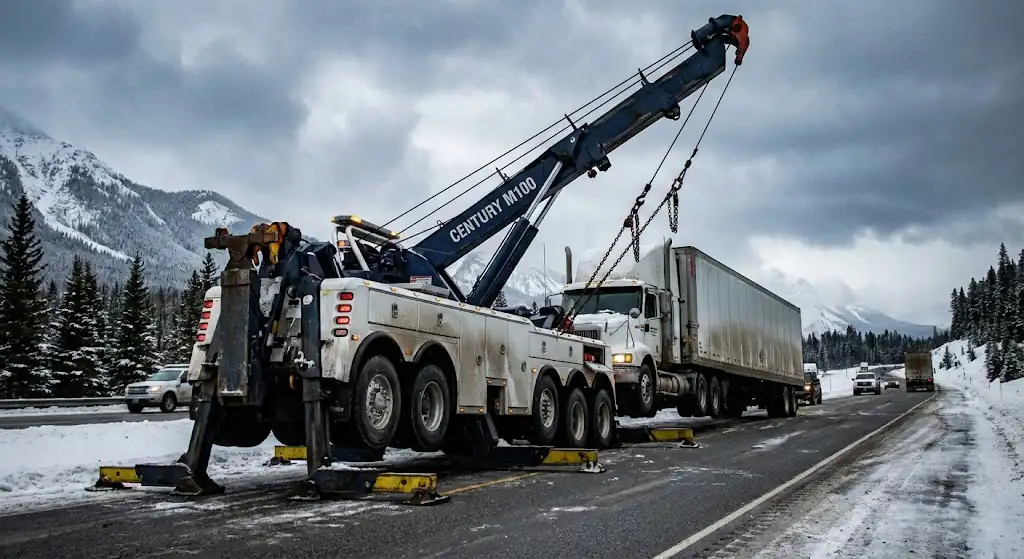
Trailer is undriveable (lost wheel, structural damage): This may require our heavy-duty towing to transport the trailer separately. For large trailers, RVs, and equipment trailers, see our RV towing service.
Both vehicle and trailer need towing: In severe breakdowns (collision, major mechanical failure), we may dispatch two trucks — one for the tow vehicle and one for the trailer. For pricing details, call ahead for a quote based on your specific combination.
7 Safety Tips for Towing in Calgary
1. Load 60% of cargo weight forward of the trailer axle. Proper tongue weight (10–15% of total trailer weight) prevents sway. Too much weight behind the axle causes “tail wagging” at speed.
2. Reduce speed. Towing increases stopping distances by 2–3x. Drop your highway speed by 10–15 km/h below the posted limit, especially in wet or icy conditions. Calgary’s chinook weather creates variable road conditions that change by the hour.
3. Use tow mirrors. If your trailer is wider than your tow vehicle, you need extended tow mirrors. Alberta requires you to have clear visibility of both sides of the trailer and the road behind it.
4. Check trailer tire pressure before every trip. Trailer tires lose pressure faster than car tires because they sit unused for long periods. Under-inflated trailer tires are the leading cause of trailer blowouts. Read our tire pressure and cold weather guide for more.
5. Practice backing up before you need to. An empty parking lot on a quiet Sunday morning is the place to learn trailer backing — not a crowded campground or boat launch.
6. Know your route. Low overpasses, tight urban turns, and narrow mountain roads can be impassable with a trailer. Plan ahead — Google Maps allows you to avoid routes with low clearances and narrow roads.
7. Carry a trailer emergency kit. Spare trailer tire, lug wrench (correct size for trailer lugs — often different from your vehicle), wheel chocks, reflective triangles, and a basic tool kit. Add this to your winter emergency kit during cold months.
Does Insurance Cover Trailer Breakdowns?
Insurance coverage for trailers is separate from your vehicle insurance — and many Calgary drivers do not realize this until they need it:
Your auto insurance does not automatically cover the trailer. Your vehicle policy covers the tow vehicle. The trailer itself (and its contents) may need a separate policy or an endorsement added to your existing policy. Check with your insurer.
Roadside assistance coverage varies. AMA and some insurance roadside programs cover the tow vehicle but may not cover the trailer. If your trailer breaks down separately, you may need to pay out of pocket for its tow. Verify your coverage limits. For more on how insurance applies to towing, see our Alberta insurance and towing guide.
Collision coverage for the trailer. If you are in an accident while towing, damage to the trailer (and its cargo) is typically covered only if you have trailer-specific insurance. This is especially important for expensive cargo like boats, ATVs, or equipment.
Frequently Asked Questions: Trailer Towing Calgary
Do I need a special licence to tow a trailer in Alberta?
A standard Class 5 licence covers trailers weighing up to 4,600 kg without air brakes. If your trailer exceeds 4,600 kg, you need a Class 5 licence with a Code 51 (heavy trailer) endorsement. Air-brake-equipped trailers require a Class 1, 2, 3, or 4 licence.
Does my trailer need brakes in Alberta?
Yes, if the gross laden weight of the trailer is 909 kg (2,004 lbs) or more, or if the trailer’s gross weight exceeds half the weight of the towing vehicle. An independent braking system (electric, surge, or air) is required. Most loaded utility, boat, and RV trailers exceed this threshold.
What speed should I drive when towing a trailer in Calgary?
There is no separate speed limit for trailers in Alberta — the posted limit applies. However, reducing your speed by 10–15 km/h below the posted limit is strongly recommended when towing. Your stopping distance is 2–3x longer with a trailer, and trailer sway risk increases with speed.
Can you tow my trailer if it has a flat tire?
Yes. We provide mobile tire changes for trailers on-site, including utility, boat, RV, and equipment trailers. If you have a spare, we mount it on the roadside. If not, we can tow the trailer to a tire shop. Call (587) 885-2326 and describe the trailer type and tire size.
What if my trailer comes unhitched on the highway?
If your safety chains hold, the trailer will drag behind the vehicle — slow down gradually and pull to the shoulder. If the trailer separates completely, it becomes an uncontrolled hazard. Call 911 immediately. This is why pre-trip checks, proper coupling, and crossed safety chains are critical.
How do I stop trailer sway?
Do not brake sharply or steer aggressively. Instead, ease off the accelerator to let the vehicle slow naturally. If you have a manual trailer brake controller, gently apply the trailer brakes only. Prevent sway in the first place by loading 60% of cargo weight forward of the axle, not exceeding your tow rating, and reducing speed in crosswinds.
Can I tow two trailers in Alberta?
Yes, but only if the lead trailer is a fifth wheel with at least two axles in tandem. The combined length from the front of the tow vehicle to the rear of the last trailer cannot exceed 20 metres. The second trailer must be hitched to the frame of the first trailer, not the bumper.
Does my trailer need its own licence plate?
Yes. All trailers towed on Alberta roads must be registered and display a valid licence plate. Registration can be done through a registry office. The plate must be visible from the rear of the trailer.
What equipment hauling services do you offer for trailers?
We handle trailer towing for breakdowns, flat tires, and transport. For larger equipment trailer needs, our equipment hauling service covers construction and industrial trailer transport across Calgary and Alberta.
How often should I service my trailer?
Before the start of each towing season and annually at minimum: repack wheel bearings, check brake pads and adjustment, inspect tires for wear and dry rot, test all lights and wiring, lubricate the coupler and jack, and inspect safety chains for wear. Trailers that sit unused for months are more prone to problems than those used regularly.
Trailer Trouble? We Handle the Whole Combination.
Flat tire, lost wheel, tow vehicle breakdown — we dispatch the right equipment for your setup.
24/7 across Calgary and all Alberta highways.