
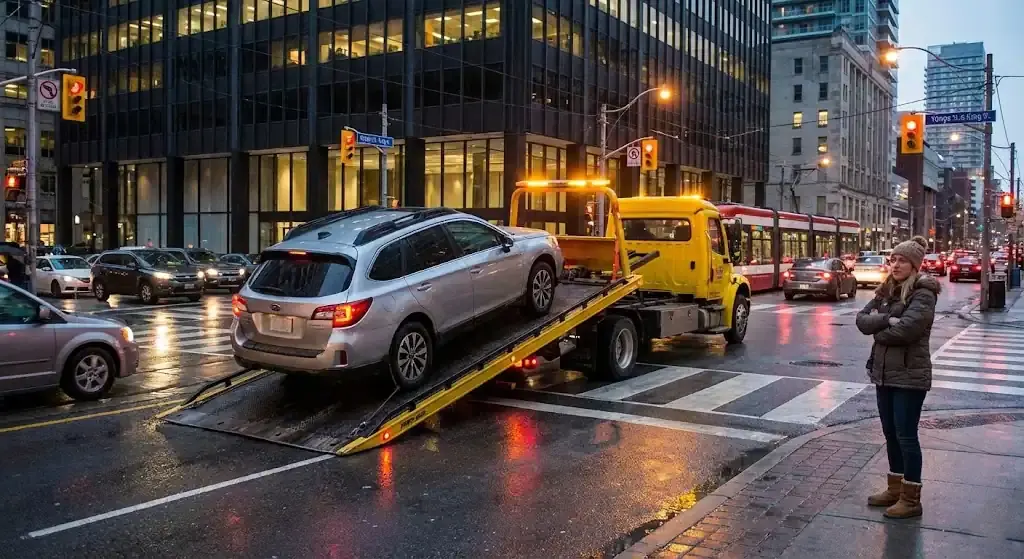
An AWD badge does not tell you the complete towing procedure. Check the instructions for the exact vehicle and tell the operator its condition and pickup location. A flatbed or an appropriate wheel-lift-and-dolly arrangement may keep all wheels off the road, but suitability must be confirmed for that vehicle and job.
If your all-wheel-drive car has broken down in Calgary, you may have heard that only a flatbed can move it. You may also have been told that selecting neutral makes any towing method acceptable. Neither shortcut is a substitute for the manufacturer’s instructions and an operator’s assessment. The useful decision combines drivetrain requirements, wheel condition, loading access and destination.
This guide helps you ask informed questions before transport. It is not a procedure for attaching a vehicle, releasing a transmission or towing behind a friend’s car. For a service request, see flatbed towing in Calgary and supply the information outlined below.
Calgary Tow Truck connects you with independent operators. Share the vehicle, location and access details, then confirm service availability and the complete quote.
Start with the exact vehicle
Give the year, make, model and trim or drivetrain information you can verify. Mention whether the car is AWD, four-wheel drive, hybrid or electric. If you are unsure, say so. A similar-looking model may use a different drivetrain, and a badge alone may not identify all the transport restrictions.
Locate the towing or vehicle-transport section of the correct owner’s manual. Instructions for emergency recovery, loading onto a carrier and recreational towing behind a motorhome may describe different situations. Do not apply a short repositioning exception to a road journey, or assume that a motorhome towing instruction applies to breakdown recovery.
For example, the Hyundai manual referenced below specifies wheel-lift-and-dolly or flatbed equipment with all wheels off the ground for the AWD vehicle it covers. That is a model-specific instruction, not a universal permission for every vehicle. Your operator must confirm the applicable method and any additional loading requirements.
Understand what the equipment does
A flatbed carries the vehicle on a platform after loading. This can keep the vehicle’s road wheels from rotating during transport. However, getting onto that platform is a separate task. A low bumper, collapsed suspension, flat tire or wheel that will not turn can affect the loading plan even when a flatbed is available.
A wheel lift raises one end of a vehicle. Where suitable, dollies support the other wheels so they are also off the road. The operator must assess the complete arrangement, its capacity and the manufacturer’s requirements. The word “dollies” alone is not enough information to judge whether a proposed setup is appropriate.
Ask a simple question: “How will your proposed method meet this vehicle’s transport instructions?” This invites a useful explanation. Avoid selecting equipment only from its name or asking someone to copy a setup you saw in a photograph. Vehicle condition and access can change what is practical.
Neutral is not a universal solution
Selecting neutral does not by itself establish that road towing is permitted. The relevant instructions may still require all wheels to be lifted or describe other restrictions. Do not infer permission from the fact that the vehicle can be pushed a short distance in a parking space.
A dead low-voltage battery or electronic fault may also affect gear selection or parking-brake release. Tell the operator if the car cannot select neutral, cannot steer or has locked wheels. Do not force controls or disconnect components to make the job look simpler. A missing key is another detail that should be disclosed before dispatch.
If the car has stopped because of a starting problem rather than damage, breakdown towing to a repair shop may be the next step after suitable assessment. Explain what happened before the failure. This gives the operator a clearer picture than requesting a particular truck without describing the car.
Calgary Tow Truck connects you with independent operators. Share the vehicle, location and access details, then confirm service availability and the complete quote.
A parkade changes the access plan
An appropriate road-transport method still has to work with the pickup location. A flatbed that suits the vehicle may not fit inside an underground garage or turn through a narrow access lane. Provide the posted height, ramp details, level, stall and any gate restrictions when requesting low-clearance vehicle recovery.
The operator may need to assess removal from the space separately from the onward road journey. Ask whether a transfer to another vehicle is anticipated and whether the quote includes both stages. Do not assume that the equipment entering the building will necessarily carry the car all the way to the destination.
Keep the exit route available where you can do so without moving other people’s vehicles or interfering with building equipment. Contact the property manager for access arrangements. Never push the car down a ramp merely to reach a larger truck; managing an immobilized vehicle on a slope is a professional task.
Damage and modifications matter
Report a flat or missing tire, damaged wheel, steering problem, suspension damage or bodywork hanging near the ground. If the vehicle was in a collision, describe what you can see from a safe position rather than trying to determine whether it is mechanically sound. Accident recovery assistance involves different considerations from an ordinary no-start.
Also mention lowered suspension, a body kit, unusual wheels or other changes affecting clearance and loading. Do not crawl underneath a disabled vehicle to collect information. A few clear photographs taken safely can help the operator understand the request, but photographs do not replace an on-site assessment.
For tire damage, our guide to driving on a flat tire explains why a nearby destination does not make continued driving safe. The tow decision should account for the actual damage, not just the distance to a shop.
Agree on the journey and handoff
Choose a receiving shop that can accept the vehicle and the type of fault involved. Confirm the entrance and unloading location before booking. For after-hours delivery, obtain the shop’s permission and key instructions. A tow booking does not create a repair appointment or authorize leaving the car on private property.
If the car is travelling outside Calgary, explain the full route request and delivery timing from the start. Our long-distance towing service information covers the transport discussion. Do not assume a quote for a local move applies to a journey to another city.
Ask whether the total covers loading, dollies or other required equipment, restricted-access work, distance, waiting and taxes. Use the Calgary towing cost checklist to compare the same scope across quotes. An equipment label by itself is not a complete price or service description.
AWD towing questions
Can an AWD car be towed with two wheels on the road?
Do not assume that is permitted. Check the exact vehicle’s manual and require the proposed method to follow it. Neutral alone does not establish permission.
Are dollies always an acceptable alternative to a flatbed?
No. An appropriate arrangement may be allowed for some vehicles, but the operator must confirm manufacturer requirements, equipment capacity, vehicle condition and the intended journey.
What if the car will not roll or select neutral?
Say this before dispatch. The loading approach may need different equipment or preparation. Do not force a release or try to drag the car into a more convenient position.
Does a short tow make the instructions less important?
No. A short destination distance does not remove loading or drivetrain requirements. Any limited movement allowance must come from the correct instructions and apply to the actual situation.
Need transport for an AWD vehicle?
Calgary Tow Truck connects you with independent operators. Share the vehicle, location and access details, then confirm service availability and the complete quote.
Reference: Model-specific AWD towing precautions. Follow the instructions for your exact vehicle and circumstances.